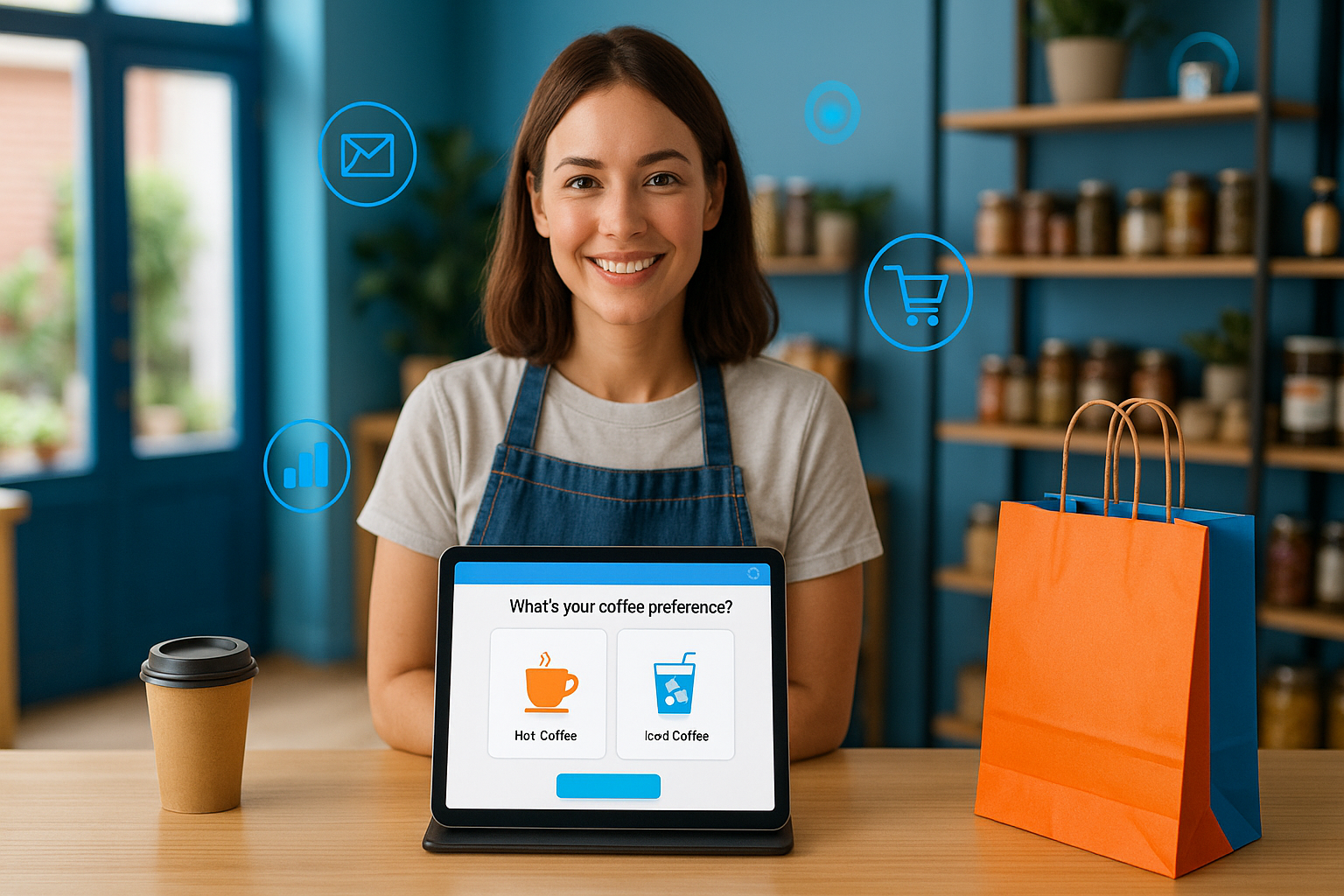
If you’re running a small business, you’re probably juggling paid ads, social posts, emails, pop-ups—yet still fighting for predictable leads and sales. Here’s the good news: quiz marketing gives SMEs a fast, affordable way to convert curiosity into customers. In 2025, quizzes aren’t fluffy gimmicks—they’re your most efficient interactive lead magnet, first-party data engine, and evergreen conversion asset rolled into one.
In this cornerstone hub you’ll learn how quiz funnels work for SMEs, the exact types of quizzes that drive growth, where to place them, what to offer as a value exchange, and how to plug everything into your email, CRM and ecommerce stack. We’ll also share anonymised results from small and mid-sized businesses using quiz journeys today, and point you to practical playbooks to launch in days—not months. (All examples are anonymised by industry only.)
Why quiz marketing matters for SMEs in 2025
- Ad costs are up; attention is down. Static lead magnets struggle to compete with short-form, swipe-happy behaviour. Quizzes meet people where they are: tapping, swiping, choosing—and finishing.
- You need first-party data. A well-designed quiz ethically earns preferences, intents and obstacles directly from customers (no third-party cookies required).
- You must segment to sell. Quizzes sort visitors into actionable groups so you can tailor product recommendations, emails, and offers with far better relevance (and less manual effort).
- They’re quick to launch. Compared with full website rebuilds or complex funnels, an SME-grade quiz can go live in days and start paying back immediately.
If you’re thinking, “We’ve tried pop-ups and PDFs—didn’t move the needle,” that’s exactly the point. In our blog plan, we specifically stack quizzes against static lead magnets—and show why quizzes win on completion rate, data depth and conversion quality (see our “interactive lead magnets” deep-dive in the plan).
The SME quiz funnel, explained
At a high level, a quiz funnel moves people through four stages:
- Hook → an enticing question or promise (“Find your best-fit…”, “What’s your style…?”).
- Engage → 5–9 lightweight questions mixing preference, behaviour and barrier checks.
- Convert → results + value exchange (discount, guide, personalised tips) behind a simple form.
- Follow-up → segmented email sequences, retargeting, and on-site recommendations.
What you collect (and why it converts)
- Profile (new vs returning, basic contact)
- Preferences (taste, budget, use-case)
- Readiness (timeline, blockers)
- Signals (high-intent answers that map to your offers)
This isn’t “nice to have” data. It’s the difference between spray-and-pray emails and segmented flows that match offers to actual needs—lower unsubscribes, higher click-through, higher revenue.
Five quiz types that work best for small businesses
1) Product-match quiz (best for ecommerce & retailers)
Use when: You sell multiple SKUs or collections and customers ask “Which one is right for me?”
Goal: Reduce choice overload, grow email list, lift add-to-cart.
Example payoff: An equestrian retailer ran seasonal product-match quizzes around launches and events, driving ~16,000 plays in three weeks with 66% of completions opting in—strong signals for follow-up campaigns and retargeting.
Quick build: 7–9 questions → category, fit, budget, frequency → result: “Your perfect bundle” + incentive.
2) Style/personality quiz (best for boutiques, salons, lifestyle brands)
Use when: You need a fun, brand-led hook that maps to curated results (looks, routines, bundles).
Goal: Capture first-party preferences and drive themed email series.
Quick build: 6–8 questions with visual answers; results map to 3–5 personas (“Minimalist”, “Bold”, “Classic”) with product picks.
3) Readiness/assessment quiz (best for services & local SMEs)
Use when: You sell services and want to pre-qualify prospects and set expectations.
Goal: Shorten sales cycles by knowing “who needs what”—and when.
Quick build: 8 questions scoring readiness (budget, timeline, core needs) → result explains next best step and invites a consult.
4) Seasonal campaign quiz (best for fast list growth & social reach)
Use when: You need buzz around holidays, launches, or events.
Goal: Spike engagement and opt-ins; pair with a time-boxed incentive.
Example payoff: A Nordic FMCG brand ran themed quizzes around drinks and holiday content, achieving 3k–5k plays per quiz and collecting ~2,000 email addresses from a niche audience—proof that seasonal hooks + prizes drive rapid list growth.
5) Event/POP-UP quiz (best for exhibitions, markets, in-store)
Use when: You need to stand out offline and continue the conversation online.
Goal: Capture in-person interest with QR codes, then segment and follow up.
Example payoff: An energy hardware exhibitor used a QR-led quiz at a trade show, pulling in 518 unique players and 35% opting in for follow-up—excellent for post-event nurturing.
Anatomy of a high-converting SME quiz
Question count: 5–9 total
Time to complete: 45–90 seconds
Question mix:
- 2–3 preference questions (style, use-case)
- 2 barrier questions (budget, concern)
- 1–2 intent questions (timeline, purchase context)
- 1 “fun” or brand-flavour question (keeps momentum)
Results page essentials:
- Personalized summary in plain English
- 1 primary call-to-action (e.g., “See your picks” / “Book your free fit call”)
- 1 secondary CTA (e.g., download guide, follow on social)
- “Why this result?” explainer to build trust
- Social-share option (on brand)
Value exchange (for email opt-in):
- Discount or bonus for ecommerce
- Mini-guide/checklist for services
- Entry to seasonal prize draw (time-limited)
- VIP early access to drops
Data policy & UX: Clear consent language and accessibility-friendly design from the outset. (Our blog template bakes in compliance checkpoints for GDPR & accessibility.)
Where your quiz should live (and how to distribute it)
On-site:
- Homepage hero/feature tile during campaigns
- Dedicated landing page for ads and SEO
- Product/category pages (for match quizzes)
- Blog posts (embed mid-article as an interactive lead magnet)
Off-site distribution:
- Social (organic + paid)
- Email newsletters (“Take the 60-sec quiz”)
- QR at events, packaging inserts, receipts
- Partners/affiliates (co-branded quizzes)
We maintain a distribution and orchestration playbook (multi-channel rollouts, tracking) in our content plan—ideal when you want to scale beyond one channel.

Plugging quiz data into your stack
For ecommerce:
- Trigger browse/add-to-cart emails based on result segment.
- Use result tags to power on-site recommendations and personalisation.
- Create retargeting audiences from high-intent answers (e.g., “Ready to buy in < 30 days”).
For services/local:
- Auto-route enquiries to the right service tier.
- Pre-qualify leads before discovery calls with “readiness” scoring.
- Send dynamic proposals aligned to quiz outcomes.
Tracking basics:
- UTM-tag every distribution link (we include a builder in our social templates).
- Track completion, opt-in rate, and revenue per segment.
- Compare against prior lead magnets; look for higher CVR and lower CPA.
“Done-in-a-week” SME launch plan
Day 1 – Pick your quiz type & goal
Choose the single outcome that matters most: email growth, consultation bookings, or product discovery.
Day 2 – Draft questions
Use the mix above. Keep language simple; test with a colleague.
Day 3 – Build & brand
Create the quiz with your colours, fonts, and imagery. Map answers → result segments → recommended products/services.
Day 4 – Wire follow-ups
- Ecommerce: 3-email sequence: Your picks → Social proof → Offer with urgency.
- Services: 3-email sequence: Assessment summary → Case proof → Book a call.
Day 5 – Publish & distribute
Launch the dedicated landing page; add homepage tile; schedule social + email; prep QR for store or event.
Day 6 – Measure & iterate
Check drop-off by question; tighten copy; adjust incentives; refine results page.
Day 7 – Scale
Spin up a seasonal variant or run lookalike ads to top-performing segments.
For deeper dives, this hub links out to our pillar content (funnels, distribution, multilingual, and more) so you can expand at your own pace.
Real-world SME results (anonymised)
- Specialty retail (events + seasonal): Thousands of plays per quiz with ~2,000 new subscribers from a modest niche audience—demonstrating how themed content + prizes can grow lists fast.
- Trade-show exhibitor (QR-led): 518 unique players over three days, ~35% consented to follow-up—rich pipeline for demos and post-show offers.
- DTC/lifestyle retailer (launch quiz): ~16,000 plays in three weeks, 66% registration rate, with most participants replaying—massive engagement and inexpensive audience building.
Common mistakes SMEs make with quizzes (and how to avoid them)
- Too many questions. More than 10 and you’ll see completion drop. Aim for 5–9.
- No clear value exchange. Tell people exactly what they get: discount, picks, VIP access, guide.
- Fluffy results. “You’re a Trendsetter” is cute, but what should I buy or do? Always attach next steps.
- No follow-up flows. The quiz is the start, not the end. Pre-write your 3-email sequence before launch.
- No segmentation tags. If every answer posts to one list, you’re leaving money on the table.
- Forgetting accessibility. Clear labels, readable contrast, keyboard-friendly inputs as standard. (See our blog template checklist.)
Tools, techniques & best practices
- Short, visual answers: Buttons with micro-icons increase taps and reduce friction.
- Progress indicator: Show % complete to reduce drop-offs.
- Result credibility: Include “Why this result?” explaining the logic.
- Social proof: Add 1–2 relevant testimonials or micro-proof points near the CTA.
- Smart incentives: Time-box seasonal rewards; use evergreen value (e.g., “Free fitting guide”) for always-on.
- Distribution rhythm: Kick off with a hero push, then drip reminders via email and social (different angles each time). Our social templates include persona-specific formats to speed this up.
How this hub links to everything else
This cornerstone is designed to connect you to deeper guides in our Quiz Marketing pillar:
- 5 Quiz Funnels That Generated 500+ Leads in Weeks → funnel patterns and examples. Focus keyword: quiz funnels.
- How Interactive Quizzes Outperform Static Lead Magnets → compare vs. PDFs/eBooks; why SMEs win with interactive lead magnets.
- Campaign Orchestration: Running Quizzes Across Multiple Channels → distribution workflows, tracking, and channel fit.
- Multilingual Quizzes: Scaling Engagement Globally → if you sell across markets or tourist flows.
(Each sub-guide is planned in our editorial calendar with meta and slugs, so you can interlink from this hub for stronger SEO and smoother reader journeys.)
Future outlook: quiz marketing in 2025 and beyond
- AI-assisted creative: Faster question drafting and on-brand results copy—still needs your human judgement for accuracy and tone.
- Privacy-first personalisation: First-party data from quizzes feeds compliant, value-led personalisation; expect more platforms to make this the default.
- Accessibility by design: Expect stronger enforcement and higher user expectations—good UX is now table stakes. Our template keeps you aligned from the start.
- Omni-channel blending: QR-to-quiz bridges offline and online; social + UGC moments continue to amplify reach (especially when paired with share-worthy results).
Wrap-up & next steps
Quizzes give SMEs an unfair advantage: they earn attention, collect useful data, and convert with relevance—without bloated budgets. Start with one quiz aligned to a single commercial outcome, wire the follow-ups, then scale into seasonal or event variants. Use this hub as your map; the linked guides as your step-by-step instructions.
In 7 days, you can have a working quiz funnel that captures leads daily and informs every campaign you run next.
Ready to see this for your business?
Book a demo and we’ll show you how a quiz funnel would work for your products or services—including the exact questions, results logic and follow-up sequence. CTA: Book a demo.