
f you’re still dangling a PDF in exchange for an email, you’re not alone—but you are leaving insight (and revenue) on the table. Static lead magnets struggle to earn attention in feeds, ads and inboxes. Modern audiences expect instant value, personal relevance and a little fun. That’s exactly why quiz lead generation is surging: it trades “download now, maybe read later” for a short, interactive experience that feels helpful, not heavy.
In this article, we’ll show why quizzes beat PDFs for attention, data quality and downstream conversion, and how to roll out a quiz-led funnel in days—not months. The angle is practical: richer zero-party data, stronger engagement, smarter segmentation and cleaner CRM hand-offs for campaigns that actually perform. This is written for Maya—the marketing manager under pressure to prove ROI and improve lead quality—using Playerence’s blog structure and tone guidelines.
Why this matters for marketing
You’re accountable for pipeline, not page views. You value authenticity and innovation, but you’re battling low engagement and shallow insights from “gate-and-pray” PDFs. You’re asking: How do I capture more qualified leads without inflating ad spend? Can I get actionable data that drives better segmentation and nurture? Will it integrate with our CRM and show me the numbers? Those are exactly Maya’s priorities: higher-quality leads, campaign performance, CRM integration and analytics.
The shift from static downloads to interactive quizzes isn’t just a format swap; it’s a value-exchange upgrade. Prospects get instant feedback and personalised recommendations; you get explicit preferences and intent—real, permissioned zero-party data you can actually use.
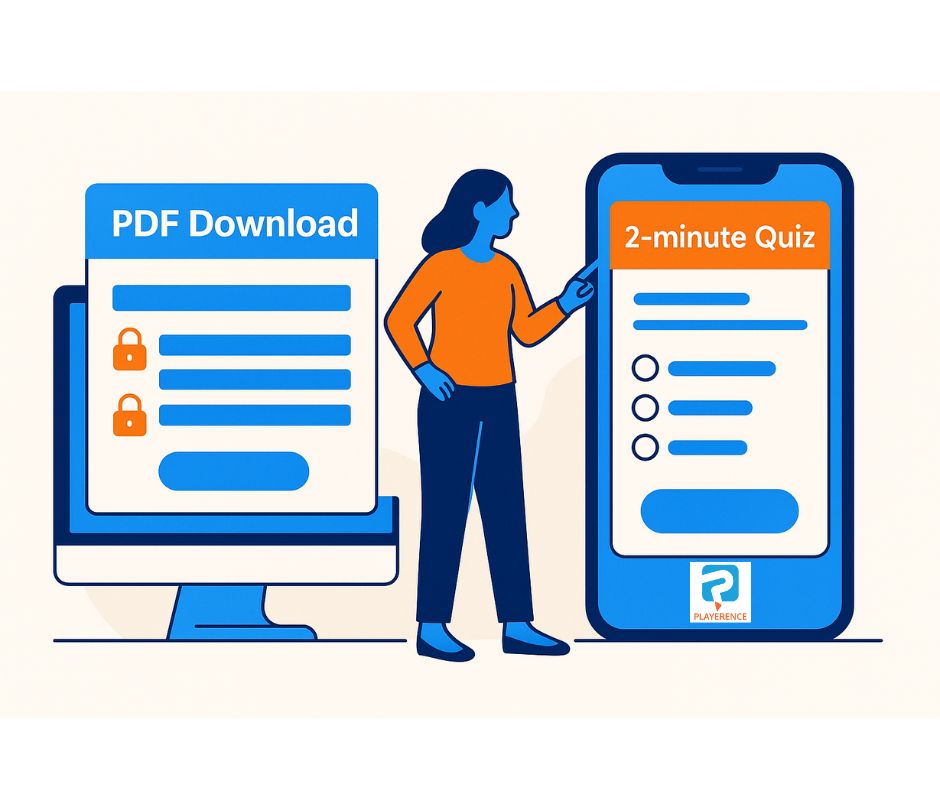
The strategy: replace (or augment) PDFs with quiz funnels
1) Quizzes convert because they feel useful, immediate and light
A well-designed quiz reframes the lead magnet as a mini-consultation: Answer a few questions, get tailored value now.This immediacy lifts participation and completion compared with “download and read later” friction. In anonymised Playerence campaigns, consumer quizzes routinely attracted thousands of plays with strong opt-in rates (see examples below), proving the engagement advantage over static assets.
2) Richer, cleaner data (hello, zero-party)
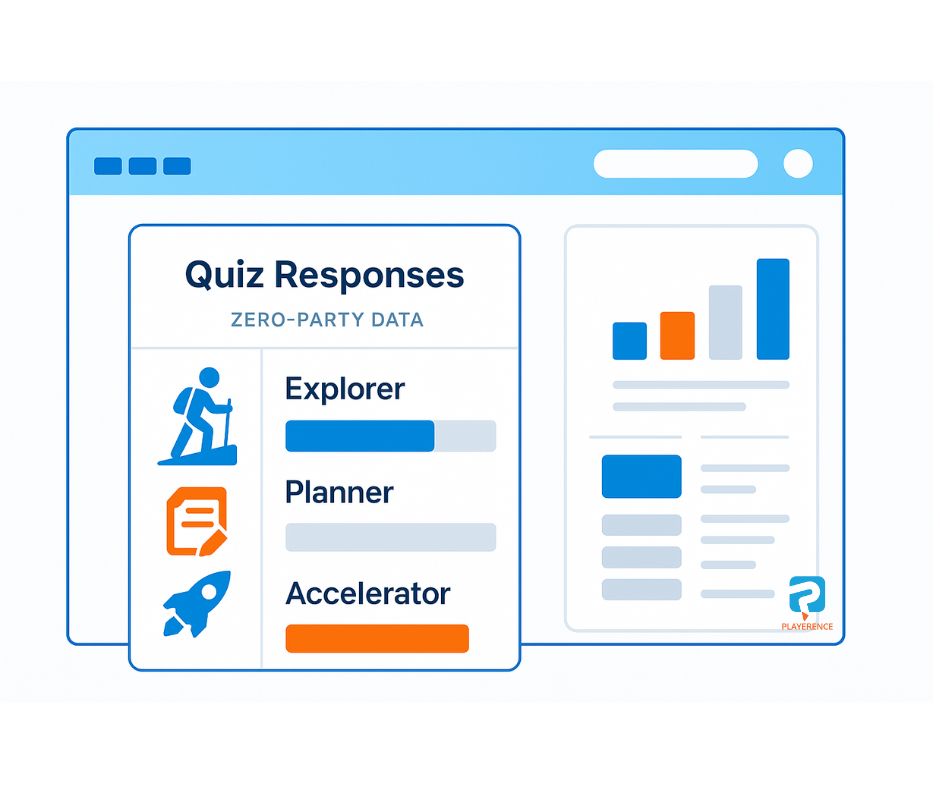
PDF forms typically collect basics (name, email, company). Quizzes, in contrast, capture specific preferences and constraints—budget bands, timelines, pains, product fit, experience level—mapped to segments and scores. For quiz lead generation, this means you can enrich contact records with what people tell you about themselves in a compliant, transparent way, then route them into the right nurture tracks from day one. This directly answers Maya’s “quality over volume” challenge.
What quizzes can capture that PDFs rarely do:
- Priority pains (“Which outcome matters most right now?”)
- Buying stage (“Just researching” vs “Shortlisting” vs “Ready to buy”)
- Feature interest (ranked) and objections
- Contextual constraints (industry, team size, geography)
- Preferred content format for follow-up (case studies, checklist, demo video)
3) Instant segmentation, smarter follow-ups (and happier CRM)
With Playerence-style quiz logic, your results map directly to segments and next steps: show a tailored result page, auto-tag the contact in your CRM, trigger the right email sequence and surface relevant sales assets. For Maya, that means cleaner reporting and more credible conversations about campaign performance. (Integration and analytics are common evaluation criteria for this persona.)
4) Multi-channel reach—and built-in “shareability”
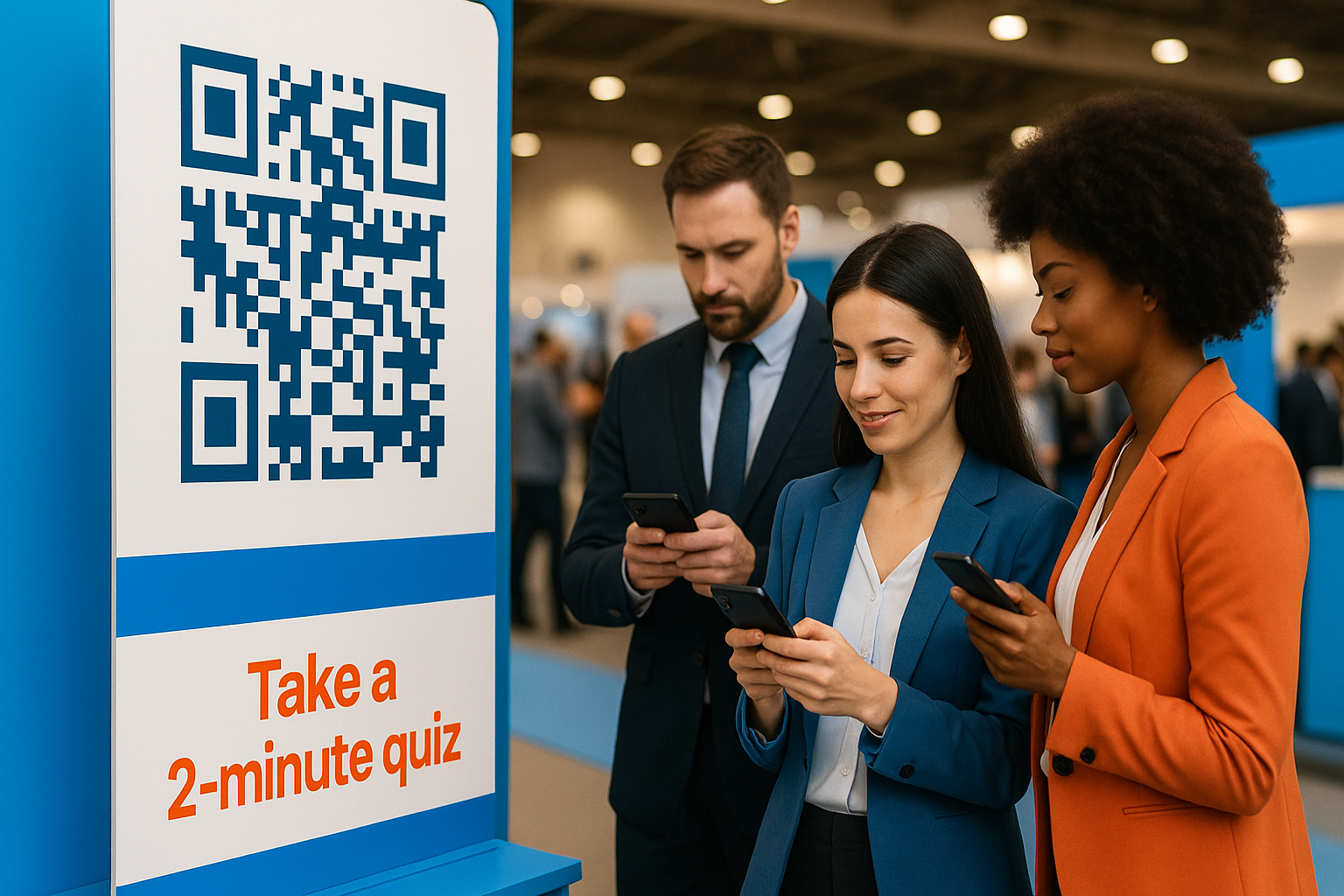
Quizzes travel well: embed on landing pages, promote in ads, run at events via QR codes, and repurpose in social. In one anonymised event activation, a hardware brand used a simple QR-led quiz on their stand and captured hundreds of engaged participants with strong opt-in for follow-up—proof that interactive beats static in crowded, time-poor environments.
Tools, techniques & best practices
Use this quick framework to launch your quiz lead generation play without overcomplicating build or governance:
- Define the value-exchange
Promise an outcome your audience actually wants in 2–3 minutes: “Find your best-fit solution,” “Benchmark your strategy,” “Identify your hidden gaps.” Keep the benefit explicit in the headline and on ads. - Align with one buying question
Anchor questions around a critical decision (e.g., “Which package fits my use case?”). Each answer should help you route people to the right message or product path. - Keep it tight: 7–10 questions
Enough for signal, not fatigue. Mix formats (multiple choice, Likert, image options). Avoid jargon. Use progressive profiling for optional extras. - Score and segment with intent
Map answers to 3–5 result archetypes (e.g., Explorer, Planner, Accelerator). Each archetype equals a segment with its own content, social proof and call-to-action. - Design the results page like a landing page
Give an immediate insight summary, two practical tips, and a next step personalised by segment (case study for risk-averse, quick-start checklist for fast movers). Offer the PDF as supporting depth, not the main event. - Integrate with CRM + marketing automation
Sync fields (segment, score, key pains, timeline). Trigger a distinct nurture path per segment. Make it reportable (campaign, channel, creative). These are explicit evaluation questions for Maya. - Handle consent and accessibility
Keep opt-in language clear and compliant. Design for keyboard navigation and readable contrasts; quizzes should be as accessible as your forms. (Future outlook below expands on compliance trends.) - Measure what matters
Don’t stop at completion rate. Track lead quality metrics: MQL-to-SQL rate by segment, pipeline per cohort, influenced revenue from quiz-originated contacts.
Real-world examples (anonymised)
These snapshots are anonymised industry cases from the Playerence library—use them for directional proof and inspiration. Never disclose names or dates.
1) FMCG brand grows audience with drink-theme quizzes
A Nordic consumer foods brand launched three short, visually appetising quizzes tied to product discovery. Promotion spanned site and social with share-for-bonus mechanics. Result: each quiz was played thousands of times; together they generated nearly two thousand new email subscribers—rich zero-party data plus momentum for the newsletter. Takeaway: light, curiosity-driven topics plus rewards drive reach and opt-in.
2) Hardware exhibitor turns footfall into follow-up
At a crowded EV expo, an energy hardware brand ran a QR-code quiz about their product benefits. Over 500 unique participants engaged during the event; around a third opted in for follow-up. Takeaway: QR-led quizzes outperform bowl-of-business-cards tactics, and the data routes cleanly to CRM for rapid, personalised outreach.
3) Specialty retail drives seasonal growth
An equestrian retailer used exhibition and holiday quizzes across languages to launch a new collection. They saw 16,000 plays in a three-week festive window with a 66% registration rate. Takeaway: campaignable quizzes excel at seasonal spikes, capturing both attention and attribute-level preference data for remarketing.
Common mistakes to avoid
- Treating quizzes like trivia
Fun is good; fluff isn’t. Every question should ladder to segmentation and usefulness. - Asking for data you won’t use
If it doesn’t route to a nurture step or sales conversation, don’t ask it. - Over-gating the result
Offer a meaningful preview on the results page; put the deeper guide (or your PDF) behind the form for those who want it. - No CRM hygiene
If you don’t map fields, tags and campaigns properly, you’ll lose the reporting battle—Maya’s nightmare scenario. - One-size nurture
If every lead gets the same follow-up sequence, you’ve squandered the segmentation value you just earned.
Future outlook / trends
- Zero-party as strategy, not slogan
Privacy expectations will only rise. Quizzes provide explicit, willingly shared data—transparent and high-signal—making them a cornerstone of consent-first growth. - Adaptive experiences
AI-assisted branching and result copy can tailor on the fly (e.g., different advice for enterprise vs SME responders) while keeping brand voice consistent. - Accessibility and inclusivity
Expect tighter standards and broader adoption of inclusive design. Build quizzes with clear language, keyboard focus states, alt text and error messaging from day one. - Quizzes as distribution hubs
Results pages that surface tailored assets (videos, case studies, comparison tools) will act as mini portals, increasing time on site and accelerating self-qualification.
Wrap-up: why quizzes beat PDFs for lead gen
- Higher engagement: short, interactive and immediate value.
- Richer data: precise preferences and intent, not just contact fields.
- Better routing: instant segmentation into the right content and nurture.
- Proven in the wild: anonymised campaigns show strong plays and opt-in rates across industries.
If you need to improve lead quality, prove ROI and keep costs sane, quiz lead generation is the fastest, most audience-friendly way to upgrade your funnel.
CTA — Download the “Quiz vs Lead Magnet Scorecard”
Ready to compare your current PDF lead magnet against a modern quiz funnel? Grab our practical Quiz vs Lead Magnet Scorecard. You’ll benchmark engagement friction, value-exchange strength, data richness and CRM readiness—and get a simple action plan to pilot your first quiz in under two weeks.
Prefer to see it in action? Book a demo and we’ll show you how teams like yours use Playerence to capture richer data, segment instantly and lift qualified pipeline—without adding headcount.